From reactivity to responsivity: an introduction to self-regulation and somatic experiencing
Three days after I graduated with my MSW, I moved from Cobble Hill, BK, to California’s Bay Area. It remains one of the most impulsive decisions I have ever made. And it paid off. No schooling or professional experience has ever impacted me more richly than the time I sept as a Wraparound Clinician at Seneca Family of Agencies, based in Oakland, CA. The bedrock of Seneca’s dynamic tapestry of practices was the Unconditional Care Model which was structured upon the foundation that clients were never kicked out of the program for presenting the behaviors, needs, or vulnerabilities that brought them into the work in the first place. I still love writing that framework out! Through the Unconditional Care Model, I learned to explore people through relational, behavioral, and environmental lenses. In my role as a clinician, I was taught how to use Carl Rogers’s “Person-centered” therapeutic approach in real time. Once I started, I never looked back; it remains the cornerstone of my therapeutic work to this day.
Seneca honored that every person holds different cognitive and learning styles. To meet those unique modes of operation, the agency entwined vibrant, creative practices drawn from Somatic Experiencing, Trauma-Focused Cognitive Behavioral Therapy, and Multi-Systemic Therapy, to truly approach clients and families in ways that were meaningful, accessible, and bespoke. The Seneca approach was holistic, comprehensive, and compassionate. But, perhaps most importantly, it worked. Some 15yrs later, I continue to integrate tools learned through the Unconditional Care Model. Today, we’re going to explore the Escalation Arc.
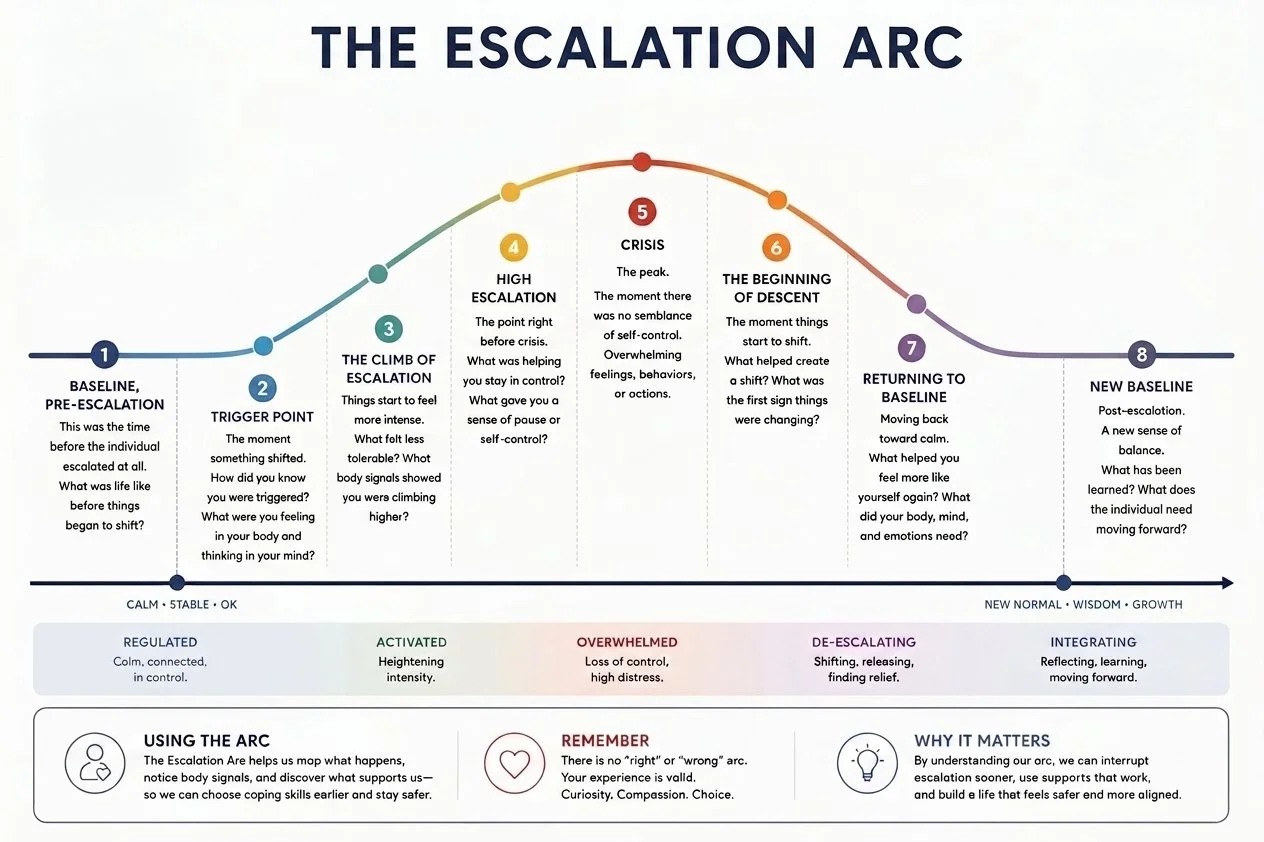
Without a doubt, the escalation arc is my favorite interactive intervention. You can use it in myriad applications and it’s effective! Pulling from Somatic Experiencing, the arc accomplishes a few things:
First, it helps us to explore the impulsive reactions we have in different circumstances and environments.
Then, it navigates the underlying needs informing our behaviors.
Finally, it supports our development and implementation of intentional responses that align with our present-day authenticity rather than moving through conditioned (often trauma-related) reactions.
The arc helps illustrate how the past may be impacting our present and serves our attunement with our own authenticity. Let’s try it out!
Dr. Peter Levine, the originator of the Somatic Experiencing school of thought, offers that when a person goes through an event, before they can cognitively interpret the incident, the body will provide primal information about the episode at hand. A common example is that if a person sees a truck careening down a hill in their direction, before they can compute, “wow, I’m so scared of that truck! Maybe I should get out of the way!” the body will react. It will flood with adrenaline, the heart rate will spike, and person will run out of the street before getting hit. Before we can contemplate cerebrally, we react physiologically. Because we are relational creatures, we similarly develop ways to cope in the context of other people or environments. We are adaptable and as such we learn (often unconsciously) to fight, run from, freeze, or fawn depending on what we learn is the most advantageous behavior based on our circumstances. If these maladaptations are repeated enough they become our baseline of operations. Overtime, these conditioned responses can even numb or mute the inherent somatic wisdom the body is built to provide. Humans are master survivors! Once we are truly in a safe environment, we start to identify what behaviors are no longer serving us, are no longer necessary. Rather than reacting impulsively out of habit, we can self-assess and operate through intentional responsivity.
This is where the arc comes in! Whether your “crisis” point is a swell of anxiety, a mode of conflict, avoidant behavior, cloying for a response, or any other landing along the behavioral spectrum, you can explore what contributes to your climb up the arc. This includes environments (like time of day, time of year, location, etc.), smells, tastes, relationships, behaviors of your own or others that catalyze your personal activation. As detectives, this is how we learn about your ascent up the climb and similarly, what serves your soothing and de-escalation. What are the inherent coping skills you use, the activities you gravitate towards, the people you reach out to, the places to which you take yourself in order to decompress and truly come back to neutral?
How we apply it now
To use the arc, recall a single time you recently engaged in the behavior you’re hoping to adjust.
1: Before anything else, map out the timeline of your climb and how your behavior shifted throughout the ascent and later through the descent.
As you recall the logistics of the climb, notice how your body feels contemplating the progression.
What is the narrative your mind has started to craft around each step of the climb and descent?
As you take your time mapping out the arc, be patient as you begin to remember how you felt in real time: the gradual shifts in sensation, thought, behavior.
2: Consider your environment: where you were, what time of day was it, what you tasted, what you smelled, what the temperature was.
As you recall the environment, notice how your body feels as you contemplate.
What is the narrative your mind has started to craft around the environmental components of the climb and descent?
As you take your time mapping out the environmental elements of the arc, be patient as you begin to remember how you felt in real time: the gradual shifts in sensation, thought, behavior.
3: Bear in mind your relationships: who was around you, what they were saying, what they were doing, who wasn’t around, what wasn’t being said, what wasn’t not being done?
As you recall the relational components, notice how your body feels contemplating the stages of the exchange (or the lack there of).
What is the narrative your mind has started to craft around each step of the climb and the descent?
As you take your time mapping out the relational components of the arc, be patient as you begin to remember how you felt in real time: the gradual shifts in sensation, thought, behavior.
By learning the inherent strengths you use to self-soothe (during your de-escalation),
you can start to integrate your coping skills earlier during behavioral activation.
As you develop an intimate understanding of your adaptations and needs, you can more compassionately take care of yourself when you feel escalated.
With a bit of intention and practice you’ll become more aware of your patterns and how you’d like to interrupt them.
Try it out and let me know what you think!
To learn more about my work and offerings, you can always email me at arielle@ariellefriedmanlcsw.com to set up a consultation, or check out my IG: @ariellefriedmanlcsw.
Resources
Somatic Experiencing International